
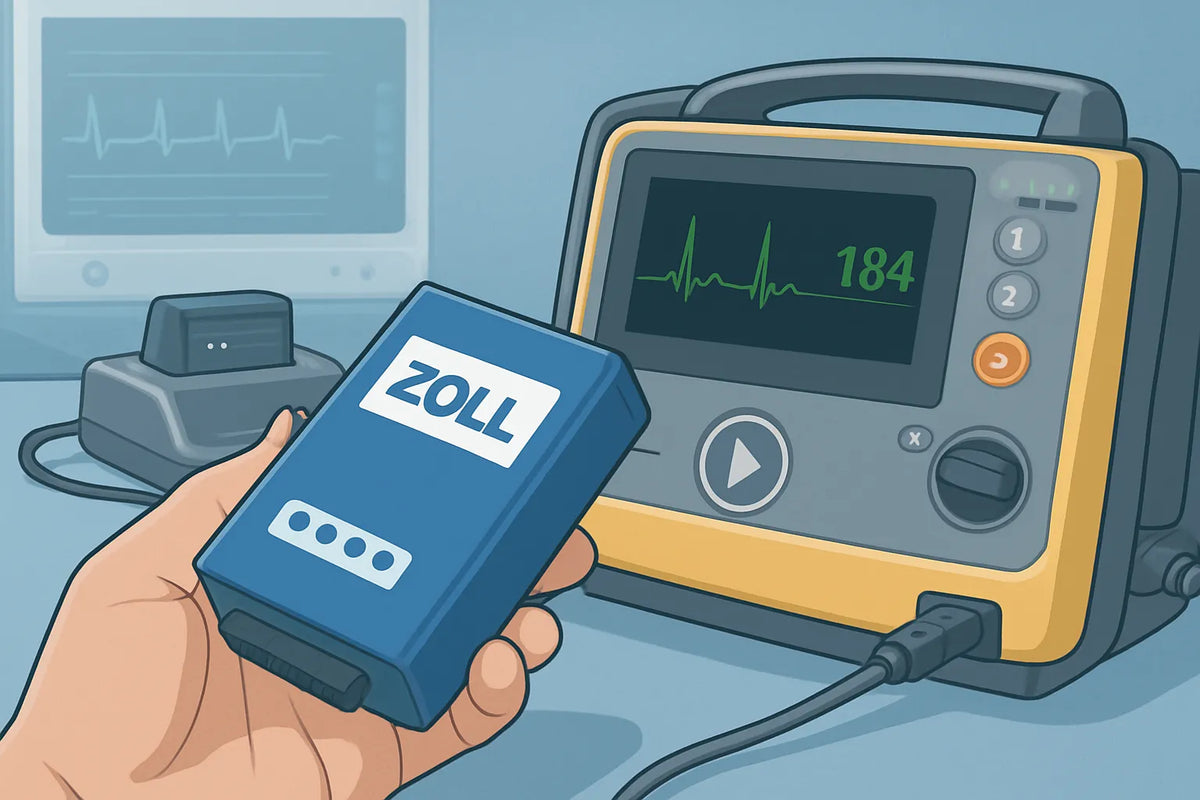
Zoll batteries power some of the most critical lifesaving devices in healthcare, including AEDs, professional defibrillators, and patient monitors. Their reliability isn’t simply a matter of convenience. A battery failure can delay intervention during cardiac arrest, where every minute without defibrillation reduces survival chances by roughly 7–10%. That makes battery health a frontline factor in emergency readiness, not just equipment upkeep.
Many hospitals, ambulance fleets, and field responders experience reduced runtime or unexpected shutdowns long before a battery’s rated lifespan ends. This often happens due to improper charging habits, poor storage conditions, or using non-OEM cells that deliver inconsistent power output. While Zoll’s lithium-manganese dioxide and lithium-ion packs are engineered for stable discharge even under high current loads, they still require correct maintenance to achieve full performance.
This guide explains practical steps to extend battery life, improve reliability, and minimize downtime. Instead of broad advice, we focus on technical behavior, usage patterns, environmental factors, and real-world practices used by EMS teams and clinical engineers. Each strategy is easy to apply whether you manage a single AED or a multi-unit medical fleet.
Understanding Zoll Battery Technology
Zoll manufactures multiple battery types designed for different device families and usage environments. While most consumer electronics rely on standard lithium-ion cells, medical defibrillators require high-current delivery, long standby life, and stable discharge even after extended storage. This makes chemistry, internal protection circuits, and power management critical to performance.
2.1 Common Battery Types Used in Zoll Devices
Most Zoll AEDs, such as the AED Plus and AED Pro, use Lithium-Manganese Dioxide (Li-MnO₂) primary batteries. These batteries are non-rechargeable but offer high energy density and stable output across a wide temperature range. They can last up to five years in standby mode, assuming periodic self-tests and minimal shock events.
Professional units like the X Series and E Series typically rely on Lithium-Ion rechargeable batteries. These packs support repeated charge cycles and deliver higher peak current needed for continuous monitoring, pacing, and repeated shocks. Their lifespan ranges from 300 to 500 charge cycles, depending on usage.
| Device Model | Battery Type | Typical Standby / Runtime | Notes |
|---|---|---|---|
| AED Plus | Li-MnO₂ (Primary) | Up to 5 years standby | Non-rechargeable |
| AED Pro | Li-Ion or Li-MnO₂ | Mixed environments | Field + clinical |
| X Series | Rechargeable Li-Ion | ~4–6 hours continuous use | Fast charging |
| E Series | Rechargeable Li-Ion | ~4–5 hours | High-demand EMS use |
These differences matter because maintenance rules are not universal. A primary battery performs best when stored cool and untouched, while lithium-ion requires active cycling and regular charging.
2.2 Key Technical Characteristics Affecting Performance
Several engineering properties determine how well a battery performs in emergencies:
-
Discharge Rate
Zoll batteries must deliver high current instantly. Large voltage drops under load signal aging cells. -
Internal Resistance
As resistance increases, the battery heats up, loses efficiency, and may shut down under peak demand. -
State of Health (SoH)
Measured over time through charge capacity retention and voltage stability. -
Self-Test Integration
Zoll devices run automated diagnostics that draw power periodically. While essential, these tests shorten standby life if batteries aren't replaced proactively.
These characteristics explain why a pack that “shows full charge” may still fail during shock delivery. Runtime numbers alone do not reflect peak performance.
2.3 OEM vs. Third-Party Batteries
Hospitals often mix aftermarket batteries due to lower cost. While many third-party packs perform well, inconsistency in cell sourcing, firmware, and protection circuits can cause reduced runtime or charging issues. Some units report errors or fail self-tests entirely.
If you choose third-party batteries, validate:
- Capacity in watt-hours, not mAh alone
- Discharge rating under load
- Temperature tolerance
- Firmware compatibility
- Certificates (UN38.3, IEC 62133, CE, FDA listing where applicable)
Price should never outrank reliability when devices may be used to save lives.
Best Practices for Charging and Maintenance
Zoll batteries perform best when charging follows controlled, predictable patterns. Improper charging is the leading cause of early capacity loss in lithium-ion medical packs, especially in EMS environments where devices are constantly docked or exposed to heat. Good maintenance extends lifespan, reduces replacement costs, and ensures power delivery during high-demand scenarios.
3.1 Charge Strategically, Not Continuously
Keeping a battery at 100% state of charge for long periods accelerates chemical aging. Lithium-ion cells degrade fastest when stored at full capacity and exposed to heat. Instead, allow discharge through normal device use before recharging.
Better habits include:
- Avoid storing batteries fully charged unless required for readiness
- Charge after each shift rather than leaving docked overnight
- Keep standby batteries at 40–60% when not deployed
This approach can preserve up to 20–30% more cycle life based on general lithium-ion aging patterns observed across medical and industrial battery systems.
3.2 Avoid High Heat During Charging
Heat significantly accelerates cathode breakdown and internal resistance. Some EMS units leave devices charging inside vehicles, where cabin temperatures can exceed 60°C (140°F), especially in summer. At that range, lithium-ion degradation can double compared to room-temperature charging.
Best practices:
- Charge in controlled indoor environments
- Avoid charging inside parked vehicles
- Keep chargers away from vents or hot medical equipment
- Allow batteries to cool before charging after use
Cold temperatures reduce power output temporarily, but heat causes permanent damage.
3.3 Use Approved Chargers and Firmware-Compatible Packs
Medical batteries rely on battery management systems (BMS) to communicate with chargers. Using incompatible chargers may:
- Slow charging
- Misread state-of-charge
- Block charging entirely
- Increase heat due to unregulated current
OEM chargers are safest for mission-critical devices, especially emergency defibrillators.
3.4 Periodic Cycling to Maintain Accuracy
Rechargeable Zoll batteries should not remain idle for long periods. Capacity readings drift when a battery remains partially charged without full discharge and recharge cycles.
To maintain accurate fuel gauge readings:
- Fully discharge and recharge every 60–90 days
- Log cycle dates during maintenance
- Test under realistic load rather than idle runtime
Testing under load is crucial because batteries that appear full may collapse during shock delivery.
3.5 Maintenance Checklist (Practical Use)
| Task | Frequency | Reason |
|---|---|---|
| Visual inspection | Monthly | Catch swelling, corrosion, cracks |
| Full charge cycle | Every 2–3 months | Recalibrate capacity |
| Thermal check while charging | Ongoing | Prevent heat degradation |
| Replacement benchmarking | Annual | Compare performance vs. new unit |
Routine maintenance isn't optional. In emergency settings, battery reliability directly influences survival rates.
Storage, Safety, and Lifecycle Optimization
Proper storage conditions extend the usable lifespan of Zoll batteries, especially when keeping spare units for deployment, fleet rotation, or disaster-response stockpiles. Even when not actively used, chemical aging continues. Your goal is to slow that process and maintain readiness without accelerating degradation.
4.1 Store at the Right Charge Level
Rechargeable lithium-ion batteries last longest when stored partially charged rather than full. High voltage accelerates electrolyte oxidation and capacity loss.
Optimal storage guidelines:
- Keep charge between 40–60% for backup units
- Avoid storing fully charged for more than two weeks
- Check and top off stored batteries every 90 days
Primary lithium-manganese batteries used in AEDs are designed for multi-year standby. However, perform periodic device checks because automated self-tests drain capacity slowly.
4.2 Control Temperature and Humidity
Temperature affects long-term capacity more than most factors. Heat increases internal resistance and causes permanent chemical damage, while extreme cold reduces temporary output but recovers once warmed.
Ideal storage conditions:
- Temperature range: 15°C–25°C (59°F–77°F)
- Humidity below 65%, avoid condensation
- Keep away from sunlight, vents, and power supplies
Storing batteries in ambulances during summer or near warm server rooms shortens life significantly. A pack stored at 40°C may lose double the capacity compared to one stored at room temperature over the same period.
4.3 Rotate Batteries to Balance Wear
If multiple packs are available, use a rotation schedule to prevent uneven aging. Some hospitals use barcodes or asset tags to track cycle counts and storage duration.
Practical tracking methods:
- Label each battery with activation date
- Track charge cycles in a shared log
- Swap in backup units every 6–12 weeks
- Compare runtime against new reference units annually
Even small steps like labeling and scheduled cycling help maintain predictable performance.
4.4 Safe Handling and Disposal
Medical batteries must be disposed of through regulated waste channels due to chemical components and potential fire risks. Never discard lithium packs in general trash or incinerators.
Best disposal practices include:
- Follow OSHA and EPA hazardous waste handling rules
- Use battery recycling programs that accept lithium packs
- Store damaged packs in fire-safe containers
- Avoid transporting swollen or punctured cells without containment
For healthcare facilities, disposal should integrate with biomedical waste workflows and emergency equipment compliance audits.
4.5 Extend Service Life Through Data Monitoring
Some professional Zoll devices allow runtime reporting and battery diagnostics through internal logs. Reviewing these reports can identify aging trends before failure occurs.
Look for:
- Sudden drop in runtime
- Rising internal resistance
- Frequent charging interruptions
- Failure during high-current peaks
A battery may appear functional during low-power standby but fail the moment a shock is required. Data-backed monitoring prevents this scenario.
When to Replace and How to Evaluate Battery Health
Even with careful maintenance, every battery eventually reaches end of life. The main goal is replacing it before it fails during emergency use. Zoll batteries are engineered to deliver consistent power until their capacity drops below safe operating levels, but aging becomes noticeable through shorter runtimes, longer charging times, and voltage drops during shocks.
5.1 Key Signs a Battery Needs Replacement
Look for these indicators during regular checks:
- Runtime drops by more than 20–30% compared to baseline
- Device reports failed or incomplete self-tests
- Battery no longer holds charge through a full shift
- Voltage drops sharply during shock delivery or pacing
- Surface swelling, cracks, corrosion, or heat during charging
Batteries showing physical deformation should be removed from service immediately.
5.2 Test Under Real Load, Not Just Standby Power
A battery may pass standby checks but still fail when delivering high current. Testing must reflect actual use conditions, especially for defibrillators that require rapid output surges.
Better assessment methods include:
- Running simulated shocks on a training mode or test load
- Timing operational use during full monitoring mode
- Comparing runtime side-by-side with a new pack
Idle runtime alone does not measure health accurately.
5.3 Replace Based on Age, Not Just Symptoms
Lithium-ion performance drops steadily after a certain number of cycles. For most medical-grade lithium-ion packs, capacity decline accelerates after 300–500 cycles, especially under high-temperature use.
General replacement benchmarks:
| Usage Type | Recommended Replacement Interval |
|---|---|
| Hospital monitoring | Every 18–24 months |
| EMS field use | Every 12–18 months |
| Disaster standby stock | Every 3–5 years (low cycle count) |
Primary lithium batteries used in AEDs should be replaced when the device logs self-test failures or reaches the manufacturer’s rated standby limit, often 3–5 years.
5.4 Validate Replacement Batteries
When sourcing replacements, verify:
- OEM or certified-compatible supplier
- Capacity in watt-hours (not just mAh)
- Safety compliance (UN38.3 / IEC 62133)
- Manufacturing date and storage conditions
- Warranty and traceability
Medical batteries should never be purchased from unknown suppliers, clearance bins, or damaged packaging sources.
