
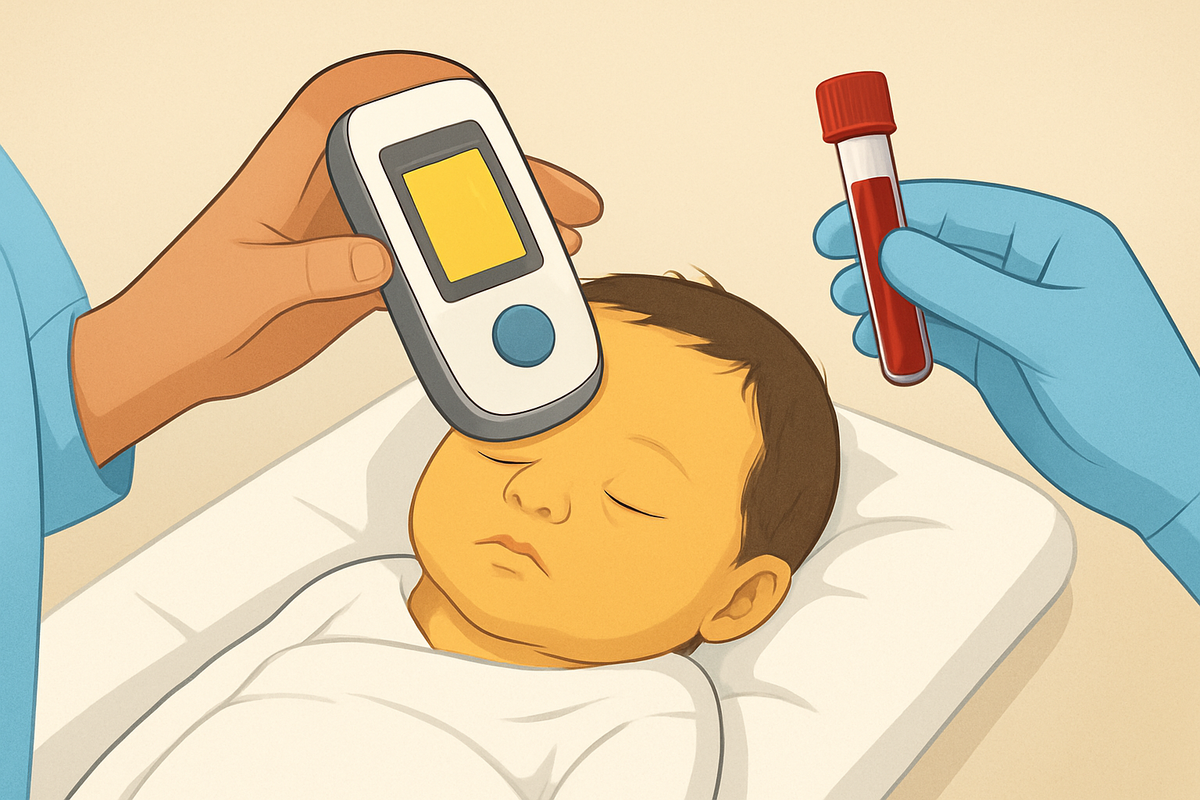
Newborn jaundice is common. About 60% of full-term babies and up to 80% of preterm infants develop visible jaundice in their first week of life. This condition occurs when bilirubin levels rise faster than a newborn’s liver can process them. In many cases, jaundice is harmless and resolves on its own. But when bilirubin climbs too high, it can become dangerous. That is why accurate screening matters.
Hospitals typically use two methods to check bilirubin levels: a jaundice meter, also called a transcutaneous bilirubin (TcB) device, or a blood test, known as total serum bilirubin (TSB). Both methods have been studied extensively, and each plays a different role in clinical decision-making. Parents often wonder which test is more accurate, less stressful, and ultimately safer for their newborn.
Understanding how each method works can help parents make informed decisions during the hectic newborn period. Screening is fast and safe, but the choice of method depends on a baby’s age, risk factors, skin tone, and medical history. Leading healthcare organizations—such as the American Academy of Pediatrics (AAP)—recommend routine bilirubin screening before hospital discharge. This guideline has significantly reduced cases of severe jaundice and related complications.
This article gives parents a clear, evidence-backed comparison of jaundice meters and blood tests. It explains when each method is appropriate, how accurate they are, and what current research shows about the safest approach. The goal is to provide reliable, easy-to-understand guidance without overwhelming new parents with medical jargon.
How Newborn Jaundice Screening Works
Newborn jaundice screening focuses on measuring bilirubin, a yellow pigment produced when red blood cells break down. Babies produce bilirubin faster than adults because their red blood cells have a shorter lifespan. Their immature livers also clear bilirubin more slowly. As a result, bilirubin can accumulate in the blood and skin during the first few days of life.
Screening aims to detect rising bilirubin levels early. Doctors look at several factors, including a baby’s age in hours, weight, feeding patterns, and overall health. Research shows that bilirubin levels usually peak between day three and day five. That is why routine screening during the hospital stay is essential. It helps identify babies who may develop severe jaundice after going home.
Why Screening Matters
Early detection prevents complications. Very high bilirubin levels can damage brain tissue, though this is rare when screening is done properly. Timely testing also helps doctors decide when to begin treatment such as phototherapy. Hospitals now follow standardized guidelines that use bilirubin charts to interpret results based on the baby’s age. This improves accuracy and reduces unnecessary interventions.
Two Main Screening Methods
Healthcare providers rely on two types of tests:
1. Transcutaneous Bilirubin (TcB) Screening
A handheld jaundice meter measures bilirubin through the skin. The device emits a brief flash of light and analyzes how the light is absorbed. Screening is painless and takes only a few seconds. This method gives quick estimates and is often used as the first test.
2. Total Serum Bilirubin (TSB) Blood Test
A blood sample is taken from the baby’s heel. This small sample is sent to the lab to measure bilirubin in the bloodstream. Blood testing is more accurate and is considered the diagnostic standard. Doctors use TSB results to guide treatment decisions.
What Hospitals Typically Do
Many hospitals start with TcB screening. If the reading is high or borderline, they confirm it with a TSB test. This workflow reduces the number of heel pricks but maintains high diagnostic accuracy. The AAP recommends at least one bilirubin measurement for every newborn before discharge.
Below is a simple comparison for clarity:
| Screening Method | What It Measures | Accuracy Level | Invasiveness | Typical Use |
|---|---|---|---|---|
| Jaundice Meter (TcB) | Bilirubin through the skin | Good for screening | Non-invasive | Initial check |
| Blood Test (TSB) | Bilirubin in the blood | Highly accurate | Mildly invasive | Confirmation and treatment decisions |
Both methods work together to ensure newborns are safe. When used correctly, they minimize the risk of missed diagnoses while avoiding unnecessary blood draws.
Jaundice Meter (TcB) Testing: How It Works, Benefits, and Limitations
Transcutaneous bilirubin (TcB) testing has become a standard part of newborn care because it offers a fast, gentle way to screen for jaundice. Hospitals worldwide use handheld jaundice meters to estimate bilirubin levels without drawing blood. The method is safe, non-invasive, and efficient, making it especially helpful during the busy postpartum period.
How TcB Testing Works
A jaundice meter sends a brief flash of light into a baby’s skin, usually on the forehead or chest. The device measures how the light is absorbed and reflected. Bilirubin has a distinct absorption pattern. The device uses this data to estimate bilirubin concentration beneath the skin.
The entire process takes only a few seconds. Babies often sleep through it. Results appear instantly on the device screen, allowing healthcare staff to make quick decisions.
Clinical Benefits of TcB Testing
TcB screening offers clear advantages, especially for routine newborn checks. Research shows that TcB devices correlate strongly with blood test levels, particularly when bilirubin values are in a safe or moderate range.
Key Benefits
-
Non-invasive and painless
No heel pricks are required, reducing stress for both parents and infants. -
Immediate results
This helps nurses quickly identify babies who need follow-up testing. -
Cost-effective for hospitals
TcB testing reduces the number of unnecessary blood tests, lowering overall care costs. -
Useful for tracking trends
Doctors can repeat TcB measurements over time to observe whether bilirubin is rising or stabilizing.
When TcB Works Best
TcB readings are most accurate when bilirubin levels are not extremely high. Many hospitals rely on TcB screening for full-term infants within their first 24–48 hours. Studies also show that TcB accuracy improves when used on lighter skin tones. However, modern devices are designed to work across varied skin pigmentation with improved consistency.
Limitations and When TcB Falls Short
Although TcB is an excellent screening tool, it is not perfect. It cannot replace a blood test in certain situations.
Main Limitations
-
Less accurate at higher bilirubin levels
When bilirubin gets close to treatment thresholds, TcB may underestimate the true value. This is why elevated results often require confirmation with a TSB blood test. -
Skin factors can affect readings
Bruising, birthmarks, or darker pigmentation may slightly influence accuracy, though newer models have improved calibration. -
Not suitable after phototherapy
Light treatment changes skin bilirubin levels. Once phototherapy begins, blood tests provide more reliable data.
Typical Hospital Protocol
Most hospitals follow the same approach:
- Use TcB for initial screening.
- If the reading is near or above the phototherapy threshold, confirm it with a TSB blood test.
- Use TSB alone during treatment.
This approach reduces unnecessary heel sticks while still ensuring safe and accurate care.
Blood Test (TSB): Accuracy, When It’s Needed, and Clinical Guidelines
The total serum bilirubin (TSB) test is the gold standard for diagnosing newborn jaundice. While a jaundice meter offers a quick estimate, only a blood test can measure bilirubin directly in the bloodstream. This accuracy is critical when bilirubin levels approach treatment thresholds or when a baby shows risk factors for severe jaundice.
How the TSB Blood Test Works
A small blood sample is collected from a newborn’s heel using a sterile lancet. The sample is sent to the laboratory, where bilirubin concentration is measured using standardized biochemical methods. Results are usually available within one to two hours, depending on hospital workflow.
Although the test is mildly invasive, the heel prick is brief and considered safe for infants. Healthcare teams often use comfort techniques such as swaddling or breastfeeding to reduce distress.
Why TSB Is Considered More Accurate
TSB provides a direct measurement of bilirubin levels in the bloodstream, making it the most reliable way to diagnose jaundice. Clinical decisions such as starting phototherapy or arranging follow-up visits are based largely on TSB values.
Core Strengths of TSB Testing
-
High diagnostic accuracy
TSB is precise and not affected by skin pigmentation, bruising, or external factors. -
Essential for treatment decisions
Doctors rely on TSB results to determine whether a baby needs phototherapy or further evaluation. -
Required in high-risk cases
Preterm infants, babies showing rapid bilirubin rise, or newborns with underlying medical issues always require TSB results. -
Reliable after phototherapy
Once treatment begins, only blood tests can accurately show whether bilirubin levels are dropping.
When a Blood Test Is Necessary
Hospitals use TSB testing when accuracy is crucial. It becomes required under certain conditions.
Situations Where TSB Is Recommended
-
TcB reading is high or borderline
If a jaundice meter measurement approaches treatment thresholds, TSB is needed to confirm the actual level. -
Baby is less than 38 weeks gestation
Preterm infants have a higher risk of complications. -
Signs of hemolysis
Conditions like ABO incompatibility can cause bilirubin to rise rapidly. TSB helps monitor the trend. -
Baby appears visibly jaundiced at or after discharge
Community clinics often begin with TcB, then confirm with TSB when symptoms appear significant. -
Post-phototherapy monitoring
Because phototherapy reduces bilirubin in the skin faster than in the blood, TcB readings become unreliable.
Current Clinical Guidelines
Organizations such as the American Academy of Pediatrics (AAP) recommend at least one bilirubin measurement—using TcB or TSB—for all newborns before discharge. If risk factors are present, doctors track bilirubin levels based on the baby’s age in hours using standardized nomograms.
AAP guidelines emphasize:
- Confirming high TcB results with TSB.
- Using TSB alone for treatment decisions.
- Repeating TSB at regular intervals if bilirubin rises quickly.
- Ensuring follow-up testing within 24–72 hours after discharge for infants at higher risk.
Pros and Cons of TSB Testing
Here’s a quick, parent-friendly overview:
Advantages
- Most accurate method
- Determines treatment needs
- Works for all skin tones
- Reliable after phototherapy
Disadvantages
- Involves a heel prick
- Takes longer to get results
- Requires lab processing
- Causes mild discomfort
While it is more invasive than TcB, the accuracy of TSB makes it essential in many clinical scenarios.
Which Method Is Best? Evidence-Based Recommendations for Parents
Choosing between a jaundice meter (TcB) and a blood test (TSB) depends on your baby’s age, bilirubin trends, and overall risk factors. Both methods play important roles in newborn care, and hospitals often use them together. The key is understanding when each tool is appropriate and why doctors may recommend one over the other.
How Doctors Decide Which Test to Use
Medical teams begin by considering a newborn’s risk profile. Factors such as prematurity, bruising from birth, poor feeding, or family history of jaundice can increase bilirubin levels. Babies with these risk factors are monitored more closely.
Most newborns start with a TcB test because it is quick, painless, and reliable for early screening. If the result falls safely below treatment thresholds, no further testing may be needed. But if the value is high or borderline, a TSB test confirms the exact bilirubin level.
This layered approach helps avoid unnecessary heel pricks while ensuring high levels are not missed.
When TcB Is the Better Choice
A jaundice meter is ideal in many common situations. It works well for routine checks, especially in the first 24–72 hours.
TcB Is Preferred When:
- The baby is full-term and healthy
- Bilirubin levels appear low or moderate
- Parents want a gentle, non-invasive test
- Staff need immediate results to make quick screening decisions
TcB devices are also helpful in busy nurseries and outpatient clinics because they allow frequent checks with minimal discomfort.
When TSB Is the Safer Option
A blood test becomes necessary when accuracy must be absolute. Any baby who displays risk factors—or whose TcB reading is near the phototherapy threshold—requires a TSB test.
TSB Is Essential When:
- Bilirubin levels appear high or rising quickly
- The baby is preterm or under 38 weeks
- There are signs of hemolysis or blood-type mismatch
- The baby is receiving or has finished phototherapy
- Medical staff need exact numbers for treatment decisions
In these cases, relying only on a TcB reading could lead to underestimation. TSB ensures safe, evidence-based care.
How Both Methods Work Together
In modern newborn care, TcB and TSB are not competing methods. They are complementary tools. The combination allows hospitals to balance comfort, accuracy, and safety.
Here’s a clear breakdown for parents:
| Situation | Best Test | Reason |
|---|---|---|
| Early routine screening | TcB | Painless, fast, reliable for low-to-moderate levels |
| TcB result close to treatment threshold | TSB | Confirms accuracy and guides treatment |
| Very high bilirubin suspected | TSB | Gold standard measurement |
| After phototherapy | TSB | TcB becomes unreliable |
| Healthy, full-term baby with mild jaundice | TcB | Good for monitoring trends |
What Parents Should Keep in Mind
Parents often worry about heel pricks, but modern techniques minimize discomfort. The small moment of discomfort is outweighed by the benefit of accurate diagnosis. However, TcB offers a stress-free first step in most cases, which helps reduce the number of blood draws overall.
The most important point is that timely screening—using the right method at the right time—prevents complications. Clear communication with your healthcare team ensures your baby receives the safest and most appropriate test.
