
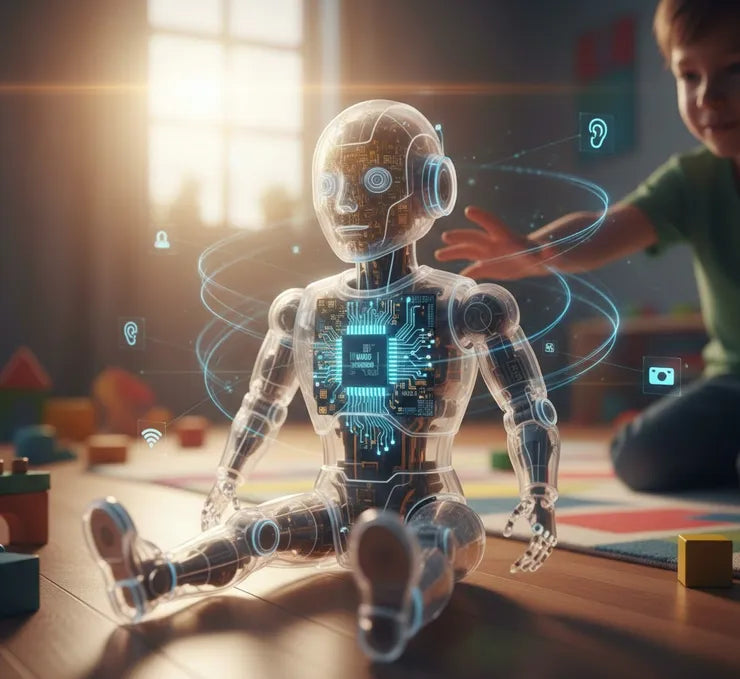
The toy aisle is undergoing its most significant transformation since the invention of the microprocessor. We are moving past pre-recorded voice chips and simple infrared sensors. Today, children are interacting with playthings that possess "cognitive" abilities.
The next generation of AI toys uses Generative AI to create unique stories. They recognize faces, understand emotional nuances, and learn from their environment. However, these sophisticated features demand immense computational resources.
The Shift from Reactive to Proactive Play
Traditional electronic toys follow a "if-this-then-that" logic. You press a button; it plays a sound. Modern AI toys, like the latest robotic companions, operate on neural networks.
These devices must process natural language and visual data simultaneously. This requires a level of "high-performance power" previously reserved for smartphones or laptops. Without a robust hardware foundation, the "magic" of AI quickly disappears.
Why Power Matters to the End User
Parents today prioritize educational value and seamless interaction. A toy that takes five seconds to respond to a question feels broken. It disrupts the child's flow and immersion.
High-performance power ensures that the AI feels "alive." It allows for local processing, which enhances privacy by keeping data off the cloud. For a parent, this represents a blend of safety and cutting-edge technology.
Defining High-Performance in the Toy Sector
When we speak of power, we are not just discussing battery life. We are talking about TOPS (Tera Operations Per Second). We are discussing sophisticated System-on-Chips (SoCs).
These components allow toys to handle complex algorithms without overheating. They support the "Evergreen" nature of modern toys. A powerful toy can receive software updates that add new features over years. This moves us away from the "disposable" culture of plastic playthings.
Key Fact: The global smart toy market is projected to reach $35 billion by 2030. This growth is driven by advancements in edge computing and low-power AI chips.
The Silicon Brain: Why Latency Kills Magic
The most critical metric for any AI-driven toy is response time. In the world of child development, a delay is more than a technical glitch. It is a psychological barrier that shatters the "illusion of life."
When a child asks a toy a question, they expect a human-like tempo. Research suggests that human conversation typically features gaps of only 200 milliseconds. If a toy takes two seconds to "think," the child loses interest immediately.
The Problem with Cloud Dependency
Many early AI toys relied entirely on cloud-based processing. They sent voice data to a server and waited for a response. This process is highly dependent on a strong Wi-Fi signal.
In a busy household, network congestion often causes significant lag. High-performance hardware allows for "Edge AI" or local processing. By handling tasks on-board, the toy eliminates the round-trip to the server. This results in near-instantaneous interactions that feel natural and fluid.
Neural Processing Units (NPUs) in Play
Modern high-performance toys now incorporate dedicated NPUs. These specialized circuits are designed specifically for machine learning tasks. They handle complex math much faster than a standard CPU.
| Feature | Standard Microcontroller | High-Performance SoC/NPU |
| Response Speed | 2.0 - 5.0 Seconds | < 0.5 Seconds |
| Speech Recognition | Keyword only | Natural Language (NLP) |
| Learning Ability | None (Static) | Adaptive (Dynamic) |
| Connectivity | Constant Wi-Fi needed | Offline/Hybrid capable |
Managing the Heat and Energy Trade-off
Higher processing speeds usually lead to increased heat. For a toy held in a child's hands, thermal management is essential. High-performance chips from 2025 and 2026 are designed with 4nm or 5nm architecture.
These smaller transistors are incredibly efficient. They provide the "muscle" needed for AI without making the toy too hot to touch. They also preserve battery life, ensuring the fun doesn't end after twenty minutes.
Real-World Impact on Learning
Speed also affects the educational quality of the toy. A high-performance device can analyze a child's reading level in real-time. It can then adapt its vocabulary instantly to match the child's needs.
This level of personalization requires heavy computational lifting. It transforms a simple plastic object into a sophisticated private tutor. Without high-performance power, this level of sophisticated, adaptive learning simply isn't possible.
Sensor Fusion: Processing Reality in Real-Time
For an AI toy to interact with the world, it needs more than just a brain; it needs sharp, integrated senses. This is achieved through sensor fusion, the process of combining data from multiple sources—like cameras, microphones, and touch sensors—into a single, coherent picture of reality.
In 2026, the baseline for "smart" has shifted from simple detection to deep contextual understanding. High-performance power is the engine that makes this possible without lag.
The Complexity of Multi-Modal Perception
Imagine a robot designed to play hide-and-seek. To succeed, it must simultaneously process visual frames to find a child, use microphones to triangulate laughter, and use infrared sensors to avoid furniture.
If these sensors work in isolation, the robot becomes clumsy and confused. High-performance hardware allows for low-level fusion, where raw data from these different "modalities" is merged at the chip level. This creates a high-fidelity map of the environment that a single sensor simply cannot provide.
Real-Time Computer Vision and Spatial Awareness
Computer vision is perhaps the most resource-intensive task for a modern toy. For a toy to recognize a specific family member or read the emotion on a child's face, it must analyze dozens of frames per second.
- Object Recognition: Identifying toys, pets, and household obstacles.
- Facial Analysis: Detecting smiles, frowns, or confusion to adjust the toy's personality.
- SLAM (Simultaneous Localization and Mapping): Allowing the toy to navigate a room without getting lost.
Executing these tasks in real-time requires significant GFLOPS (Giga-Floating Point Operations Per Second). High-performance SoCs ensure the toy "sees" and "reacts" as fast as a human would, preventing the disjointed movement common in older generations of tech.
Enhancing Safety Through Redundancy
Sensor fusion isn't just about fun; it’s about safety. When a toy uses high-performance power to cross-verify data, it becomes more reliable.
For instance, if a camera is blinded by bright sunlight, the toy can fall back on ultrasonic sensors to detect a nearby staircase. By "fusing" these inputs, the system compensates for the weaknesses of any single sensor. This ensures the toy remains a safe companion in the unpredictable environment of a child’s playroom.
The Role of Edge AI in Privacy
By processing this complex sensor data locally (on the "edge") rather than sending it to the cloud, high-performance toys offer a massive privacy advantage.
Video and audio streams never leave the device. The "silicon brain" inside the toy handles the heavy lifting, keeping the child's data secure and private. This local processing is only possible when the hardware has the horsepower to handle sophisticated neural networks internally.
The Ethics of Power: Security, Longevity, and Sustainability
As we integrate high-performance silicon into the nursery, we must look beyond raw speed. The final pillar of the next generation of AI toys is responsibility. High-performance power is not just a luxury; it is a prerequisite for ethical technology.
A powerful chip provides the "overhead" needed to run encryption and safety protocols that weaker processors simply cannot handle. This chapter examines how hardware choices impact the long-term safety and footprint of AI companions.
Fortifying the Digital Playroom
Security is the most significant concern for parents in 2026. Low-power chips often lack the resources to run advanced, real-time encryption. In contrast, high-performance SoCs include dedicated Secure Enclaves.
These are isolated areas of the processor that manage sensitive data. They ensure that even if the toy's main OS is compromised, the child’s voice and face data remain locked away. High-performance power allows for "On-Device Guardrails" that filter AI responses instantly, ensuring content remains age-appropriate without needing an internet connection.
Combating "Brick-and-Discard" Culture
The toy industry has long struggled with sustainability. Most electronic toys become obsolete within months, ending up in landfills. High-performance hardware changes this cycle by providing future-proofing.
- Software Longevity: A powerful chip can handle OS updates for five years or more.
- Adaptive Intelligence: As a child grows, the toy’s AI can evolve, moving from basic shapes to complex coding lessons.
- Modular Value: The toy becomes a platform, not just a single-use gadget.
By investing in quality silicon, manufacturers create "Evergreen" products. This reduces electronic waste by extending the functional life of the device from one season to an entire childhood.
The Sustainability of Efficiency
It may seem counterintuitive, but higher performance often leads to better energy efficiency. Modern 4nm architectures use "Race to Sleep" technology.
The processor completes a complex AI task—like translating a sentence—extremely quickly and then immediately returns to a low-power state. This efficiency extends battery life cycles. Longer-lasting batteries mean fewer charging cycles, which eventually reduces the chemical waste associated with lithium-ion degradation.
Conclusion: The Path Forward
The next generation of AI toys represents a bridge between physical play and digital intelligence. To cross that bridge safely and effectively, high-performance power is non-negotiable.
We are no longer just buying toys; we are inviting intelligent entities into our homes. By prioritizing robust hardware, we ensure these companions are fast, private, and durable. The "Silicon Brain" is what will finally allow toys to live up to the imaginations of the children who play with them.
