
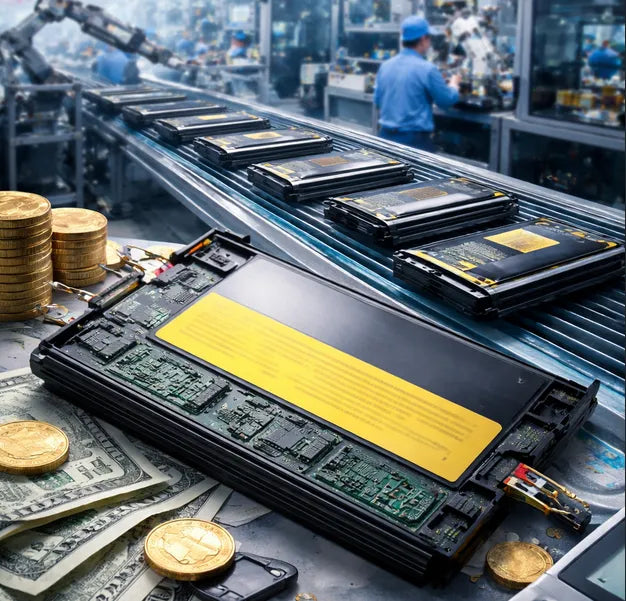
Entering the Chinese manufacturing market requires a clear financial roadmap. Many brands look to China for its mature supply chain. Cities like Shenzhen and Dongguan house thousands of specialized battery factories. However, "cheap" does not always mean "profitable" in the long run.
The Shift Toward Customization
Standard battery models are readily available for pennies. Yet, OEM production focuses on unique form factors and high performance. If you are building a rugged laptop or a slim ultrabook, off-the-shelf parts won't fit. You need a custom mold and a tailored Battery Management System (BMS).
Understanding the Cost Pillars
Three main factors dictate your final invoice. First is the Bill of Materials (BOM). This includes the cells, the protection board, and the plastic casing. Second is the Non-Recurring Engineering (NRE) fee. These are the one-time costs for molds and software. Finally, you must account for Logistics and Certification.
Why Quality Matters More Than Ever
Global safety standards like UL2054 and IEC62136 are now stricter. Cheap cells often fail these tests. A single recall can bankrupt a startup. Therefore, understanding the cost structure helps you balance price with safety. We will focus on "people-first" manufacturing that prioritizes the end-user's safety.
Current Market Benchmarks
In the current market, a standard 3-cell lithium-ion battery costs between $15 and $25. This assumes a medium-sized production run. For custom OEM projects, the initial entry price is much higher. You are paying for the expertise of Chinese engineers who refine your design.

Fixed Costs: Tooling and Engineering Fees
Starting an OEM battery project requires a significant upfront investment. These are known as Non-Recurring Engineering (NRE) costs. You pay these fees once to set up the production line. In China, these costs are lower than in the West, but they are not negligible.
Plastic Injection Molds
The battery casing requires a custom plastic mold. This mold ensures the battery fits perfectly into your laptop chassis. For a standard 3-cell or 4-cell pack, a high-quality steel mold in Dongguan typically costs between $2,000 and $5,000.
If your design is complex, the price can climb. Molds with "side actions" for unique locking mechanisms increase the complexity. A high-end, multi-cavity mold for mass production can reach $15,000. However, for most startups, a single-cavity mold is sufficient for the first 10,000 units.
BMS Development and Programming
The Battery Management System (BMS) is the "brain" of your battery. It prevents overcharging and manages heat. If you use a standard BMS, the engineering fee might be waived.
For custom OEM features—like specific communication protocols (SMBus or I2C)—you will face development fees. Expect to pay between $1,500 and $3,500 for firmware customization. This ensures the laptop software recognizes the battery and displays accurate "time remaining" data.
Production Jigs and Fixtures
Factories use specialized tools to assemble your batteries quickly. These include ultrasonic welding fixtures and testing racks. While small, these items add up. Budget approximately $500 to $1,200 for these assembly aids. They guarantee that every unit is identical and meets your mechanical tolerances.
Prototype Iterations
Before mass production, you need working samples. Most Chinese factories charge a premium for the first 5–10 prototypes. These hand-assembled units often cost $200 to $500 each. This covers the manual labor and the 3D-printed housings used before the steel mold is ready.
Variable Costs: Cell Selection and Material Sourcing
Once the fixed engineering fees are paid, your focus shifts to the cost per unit. This is largely determined by the Bill of Materials (BOM). In 2025, material prices have stabilized, but quality tiers still create wide price gaps.
The Heart of the Cost: Battery Cells
Cells account for roughly 60% to 70% of the total unit price. You must choose between two primary formats:
- 18650 Cylindrical Cells: These are standardized and cost-effective. A high-quality Grade A cell (3500mAh) from a Tier-1 maker like Samsung or LG costs about $1.60 to $2.50.
- Lithium-Polymer (Li-Po) Pouch Cells: These are thinner and customizable. They are common in ultrabooks but carry a 20-30% premium over cylindrical cells.
For a standard 3-cell laptop battery, the cell cost alone ranges from $4.80 to $9.00.
BMS and Electronics
The protection board (BMS) is the second most expensive component. A standard BMS for an OEM battery costs between $1.50 and $3.00. If you require advanced features like "smart" fuel gauging or encryption to prevent third-party usage, this cost can rise to $5.00 per unit.
Housing, Cables, and Packaging
Don't overlook the "passive" components. The plastic shell, internal wiring, and thermal pads typically cost $1.00 to $2.00. Professional retail packaging—essential for branding—adds another $0.50 to $1.20 per unit.
Labor and Assembly
Chinese factories typically charge a "processing fee" for assembly. For laptop batteries, this includes spot welding, shell sonic welding, and testing. In manufacturing hubs like Shenzhen, expect to pay $1.50 to $3.00 per unit for labor, depending on the complexity of the internal wiring.
| Component | Estimated Cost (USD) |
| Tier-1 Cells (3-cell pack) | $4.80 – $7.50 |
| BMS / PCB Board | $1.50 – $4.00 |
| Plastic Shell & Connectors | $1.00 – $2.00 |
| Assembly & QC Testing | $1.50 – $3.00 |
| Total Estimated Per Unit | $8.80 – $16.50 |
Compliance and Certification: The Hidden Expenses
For many OEM laptop battery projects, the highest financial barrier is not the production itself, but global safety compliance. Because lithium batteries are classified as "Dangerous Goods," you cannot legally ship or sell them without specific certifications.
Mandatory Transportation Testing (UN38.3)
Every lithium battery must pass UN38.3 testing to be transported by air or sea. This involves rigorous trials, including altitude simulation, thermal shock, and vibration tests.
- Cost: Approximately $1,000 to $1,500 per model.
- Requirement: You must provide about 16-20 finished battery packs for destructive testing.
Safety Standards for Market Entry
To sell in specific regions, you need localized safety certifications. If your battery fails these tests, you must pay for a redesign and re-test.
- IEC 62133 (Global): The international benchmark for battery safety. A CB (Certified Body) report typically costs $3,000 to $5,500.
- UL 2054 (North America): Often required by major retailers and Amazon. This is the most expensive certification, ranging from $15,000 to $20,000. It also requires ongoing quarterly factory audits (approx. $750/audit).
- CE / RoHS (Europe): These are self-declarations but often require a third-party test report. Budget around $500 to $1,000 for the documentation.
Why You Shouldn't Skip These
Skipping certifications might save money upfront, but it creates massive risk. Logistics providers will refuse to ship uncertified batteries. Customs officials may seize your inventory. Most importantly, without these tests, you lack proof that your product won't overheat or catch fire.Chapter 4: Compliance and Certification: The Hidden Expenses
For many OEM laptop battery projects, the highest financial barrier is not the production itself, but global safety compliance. Because lithium batteries are classified as "Dangerous Goods," you cannot legally ship or sell them without specific certifications.
Mandatory Transportation Testing (UN38.3)
Every lithium battery must pass UN38.3 testing to be transported by air or sea. This involves rigorous trials, including altitude simulation, thermal shock, and vibration tests.
- Cost: Approximately $1,000 to $1,500 per model.
- Requirement: You must provide about 16-20 finished battery packs for destructive testing.
Safety Standards for Market Entry
To sell in specific regions, you need localized safety certifications. If your battery fails these tests, you must pay for a redesign and re-test.
- IEC 62133 (Global): The international benchmark for battery safety. A CB (Certified Body) report typically costs $3,000 to $5,500.
- UL 2054 (North America): Often required by major retailers and Amazon. This is the most expensive certification, ranging from $15,000 to $20,000. It also requires ongoing quarterly factory audits (approx. $750/audit).
- CE / RoHS (Europe): These are self-declarations but often require a third-party test report. Budget around $500 to $1,000 for the documentation.
Why You Shouldn't Skip These
Skipping certifications might save money upfront, but it creates massive risk. Logistics providers will refuse to ship uncertified batteries. Customs officials may seize your inventory. Most importantly, without these tests, you lack proof that your product won't overheat or catch fire.
Summary of Certification Estimates
| Certification | Region | Estimated Cost (USD) | Timeline |
| UN38.3 + MSDS | Global | $1,200 – $1,800 | 2-3 Weeks |
| IEC 62133 / CB | Global | $4,500 – $6,000 | 4-6 Weeks |
| UL 2054 | USA/Canada | $15,000 – $20,000 | 8-12 Weeks |
| KC / PSE | Korea / Japan | $2,000 – $4,500 | 4-8 Weeks |
Summary: Calculating Your Total Investment
Bringing an OEM laptop battery to life in 2025 is a game of scale and foresight. To succeed, you must look beyond the "per-unit" price. The true cost includes engineering, compliance, and the rising impact of global trade policies.
The Minimum Order Quantity (MOQ) Factor
Most high-end factories in Shenzhen or Dongguan require a minimum order. For a custom mold, the standard MOQ is usually 1,000 to 2,000 units. If you order fewer, the factory may increase the per-unit price by 20% to 50% to cover their setup time.
Total Initial Investment Breakdown
If you are launching a new, certified 3-cell laptop battery for the US or EU market, your first-year budget should look like this:
- Engineering & Molds: $6,000 – $10,000 (Covers casing, BMS, and jigs)
- Certifications: $6,000 – $22,000 (UN38.3 + IEC + UL)
- First Production Run (1,000 units): $12,000 – $16,000
- Total Launch Capital: $24,000 – $48,000
Strategic Outlook for 2026
The landscape is shifting due to new trade measures. As of early 2025, batteries imported into certain regions, like the US, face significantly higher tariffs—sometimes exceeding 100% when combined with anti-dumping duties. Always calculate your "Landed Cost" (price + shipping + tax) rather than just the "Ex-factory" price.
Final Verdict: Is It Worth It?
OEM production is ideal if you have a proprietary laptop design or a high-volume brand. If you only need 100 units, it is more cost-effective to buy wholesale "neutral" batteries and rebrand the sticker. However, for those seeking a "people-first" product with guaranteed safety and long life, the $40,000+ entry fee is a necessary investment in your brand's reputation.
