
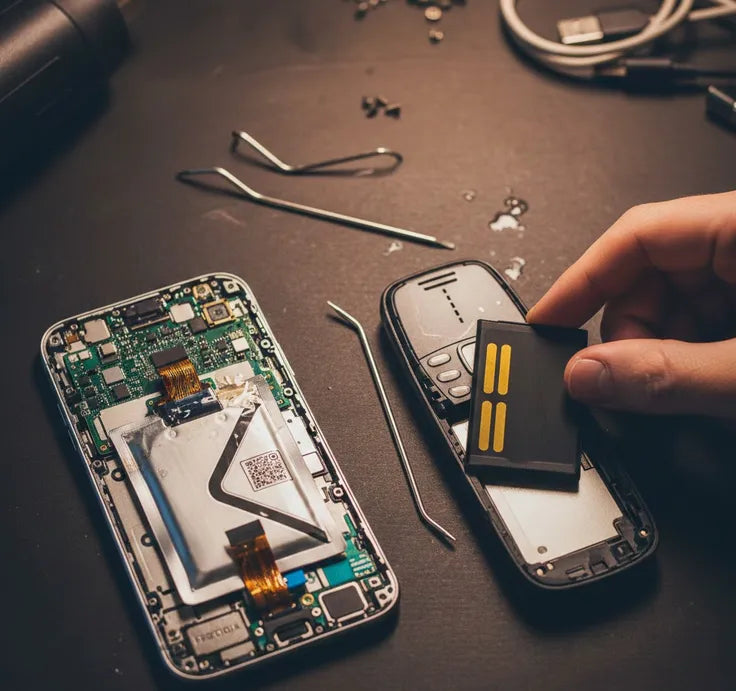
Do you remember the satisfying "click" of a Nokia battery snapping into place? For decades, electronics featured plastic tabs and accessible compartments. If your phone died, you simply popped in a spare. This was the standard for mobile utility.
However, the landscape of consumer electronics shifted dramatically around 2012. Devices began to prioritize aesthetics over modularity. This transition wasn't accidental; it was a calculated move by top engineers. Today, nearly 90% of flagship smartphones use "pouch" batteries. These cells are glued deep inside the chassis.
The Vanishing Act of the User-Replaceable Part
Modern consumers demand devices that are thinner than a pencil. They want screens that stretch from edge to edge. To achieve this, designers had to eliminate the bulk of plastic battery housings. Every millimeter of internal space is now a premium asset.
This "thin-at-all-costs" philosophy changed how we interact with hardware. It transformed our gadgets from long-term tools into disposable commodities. When the battery loses its capacity, the whole device often feels obsolete. This shift has sparked a global debate on "The Right to Repair."
Engineering Marvels vs. User Repairability
The primary reason your phone is a sealed glass sandwich boils down to one word: Integration. In the past, devices were built like LEGO sets. Components were housed in separate modules. Today, engineers treat the internal space of a smartphone like high-stakes Tetris.
To make devices thinner, manufacturers moved to "unibody" construction. This involves carving the phone's frame from a single block of aluminum or reinforcing it with glass. This structural rigidity allows for larger screens and smaller footprints. However, it leaves no room for the thick plastic doors required for removable batteries.
The Trade-off for Durability
One of the most requested features in modern electronics is Ingress Protection (IP). Users want to take photos in the rain or survive a drop in a pool. Achieving an IP68 rating requires a vacuum-tight seal.
Every opening in a device is a potential point of failure for water or dust. By removing the battery door, engineers eliminate the largest physical gap in the chassis. They use industrial-grade adhesives to bond the screen and back panel. This creates a fortress that keeps the elements out but also keeps the user from getting in.
Volume and Energy Density
Battery technology has not evolved as fast as processor speed. To keep up with power-hungry 5G chips and 120Hz displays, batteries must be larger. Standard removable batteries require a hard plastic casing to protect the volatile chemicals inside.
- Internal Space Savings: Integrated pouch batteries lack a hard shell.
- Capacity Gains: Removing the battery housing allows for 15%–20% more energy capacity.
- Weight Reduction: Glued-in batteries shave off unnecessary grams from the total weight.
| Feature | Removable Battery | Integrated (Glued) Battery |
| Water Resistance | Low (Difficult to seal) | High (IP68 standard) |
| Device Thickness | 9mm - 12mm | 7mm - 8mm |
| Energy Density | Lower (due to casing) | Higher (maximum cell size) |
| User Safety | High (Hard shell) | Moderate (Requires expert handling) |
The "Logic Board" Puzzle
As components like cameras and haptic motors grew, the battery had to change shape. Many modern laptops and phones now use "L-shaped" batteries. These are custom-molded to fit around the motherboard.
A removable battery must be rectangular to slide out easily. By gluing the battery, manufacturers can fill every nook and cranny of the device. This provides the longest possible battery life in the smallest possible frame. Unfortunately, it makes the battery nearly impossible to remove without specialized heat tools.
The Safety and Legal Landscape of Modern Power
Lithium-ion batteries are marvels of modern chemistry, but they are also highly volatile. Inside that thin silver pouch is a pressurized cocktail of flammable electrolytes. When manufacturers seal these units away, they often cite public safety as their primary motivation.
A removable battery requires a rigid protective shell. Without it, a simple drop could puncture the cell. Pouch batteries, which are common today, are soft and fragile. If a user accidentally bends or punctures one during removal, it can trigger a thermal runaway. This is a chemical fire that is nearly impossible to extinguish with water.
Liability and the "Authorized" Wall
From a corporate perspective, every DIY repair is a legal risk. If a consumer replaces their own battery and the device later catches fire, the manufacturer faces scrutiny. To mitigate this, companies use proprietary screws and strong adhesives.
These barriers ensure that only "authorized technicians" handle the internals. This protects the brand's reputation for safety. However, critics argue this is a convenient excuse to monopolize the repair market. By gatekeeping the parts, brands ensure they capture the revenue from every maintenance cycle.
The Rise of Parts Pairing
In the last five years, a new digital barrier has emerged: Software Locks. Even if you successfully swap a battery, the device may reject it. Manufacturers now "pair" the battery’s unique serial number to the motherboard.
- Warning Messages: Non-genuine battery alerts appear on the lock screen.
- Feature Throttling: Some devices disable health monitoring features for third-party cells.
- System Stability: Companies claim this ensures the power management system remains optimized.
Regulatory Pressure and Changing Laws
Governments are finally pushing back against these restrictive designs. The European Union recently passed a landmark regulation. By 2027, most portable devices must feature batteries that are "readily removable and replaceable" by the end-user.
This legal shift is forcing engineers back to the drawing board. They must now find a way to maintain water resistance while ditching the glue. It proves that "un-repairability" was often a choice, not a technical necessity. We are entering an era where law may finally override sleek industrial design.
Sustainability and the Future of Battery Design
The environmental impact of "glued-in" electronics is staggering. When a battery is difficult to remove, the entire device often ends up in a landfill. This creates a linear economy of "buy, use, and discard." This model is increasingly unsustainable as we face a global e-waste crisis.
According to the Global E-waste Monitor, the world generated 62 million tonnes of e-waste in 2022. Only a small fraction is recycled properly. When batteries are glued to the chassis, recyclers struggle to separate materials. This makes recovering valuable metals like cobalt, lithium, and nickel incredibly expensive and dangerous.
The Cost of the "Disposable" Culture
Manufacturers often argue that integrated batteries last longer. While they do offer more capacity, their lack of serviceability shortens the device's lifespan. A laptop might have a powerful processor that could last ten years. However, if the battery swells after three years and cannot be replaced, the machine becomes a paperweight.
- Carbon Footprint: Mining new minerals for a replacement phone emits more CO2 than a repair.
- Toxic Leaching: Improperly discarded batteries can leak heavy metals into groundwater.
- Resource Scarcity: Lithium and cobalt are finite resources with high environmental extraction costs.
A New Era of Circular Engineering
The tide is turning toward a "Circular Economy." Companies like Fairphone and Framework are leading the charge. They prove that you can have a modern, high-performance device with a modular battery. These brands use pull-tabs and standard screws instead of permanent adhesives.
Innovation is now focused on "Pressure-Sensitive Adhesives" (PSA). These glues hold firmly during daily use but release easily when a specific voltage or solvent is applied. This technology allows for the slimness manufacturers crave without the nightmare of permanent bonding.
The Shift to "co-Design"
The tech industry is slowly adopting "Eco-Design" principles. This means thinking about the end of a product's life at the very beginning. Designers are now being incentivized to create products that are easier to disassemble. This shift isn't just about being "green"; it's about long-term economic survival in a world of shrinking resources.
Balancing Innovation with the Right to Repair
The evolution of battery design reflects a decade of prioritizing form over function. We have moved from bulky, modular tools to sleek, integrated status symbols. While we enjoy waterproof frames and all-day power, we have sacrificed the freedom to maintain our own hardware.
The "un-repairable" trend was driven by a mix of engineering necessity and corporate strategy. However, the pendulum is finally swinging back. As consumers, we are no longer satisfied with devices that have a pre-determined expiration date. We want technology that lasts.
The Power of Informed Choice
The future of electronics is being written by both engineers and legislators. With the advent of the "Right to Repair" movement, we are seeing a return to transparency. Brands are starting to publish repairability scores, influenced by public demand for longevity.
- Support Modular Brands: Vote with your wallet by choosing companies that offer spare parts.
- Advocate for Standards: Support laws that mandate accessible battery compartments and standardized tools.
- Extend Device Life: Proper charging habits can delay the need for a difficult battery swap.
Looking Toward 2027 and Beyond
The upcoming global regulations represent a major victory for the environment. By 2027, the "glued-in" era may finally come to a close for many product categories. We can look forward to a new generation of gadgets. These devices will likely combine the sleekness we love with the utility we lost.
In summary, the difficulty of modern battery removal is a complex puzzle of chemistry and physics. Yet, it is a puzzle that is being solved. As we move forward, the "black box" of consumer electronics will slowly open up again. This will create a more sustainable and empowered future for every user.
