
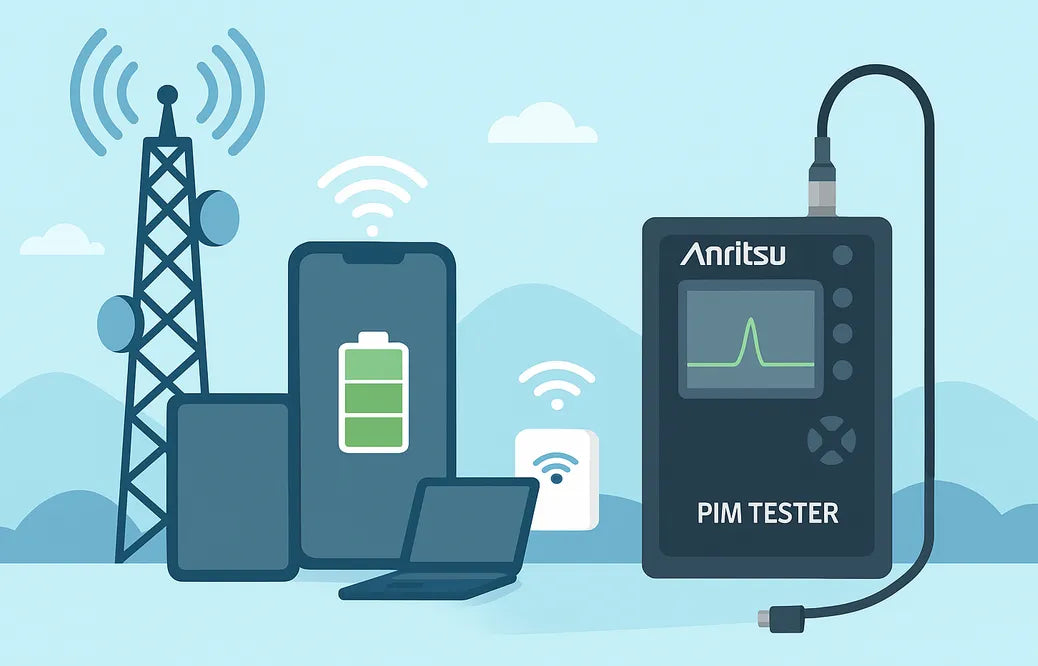
Ensuring long battery life has become a critical priority in modern wireless systems. Smartphones, IoT sensors, 5G radios, and connected industrial devices rely on stable RF environments to operate efficiently. Even small reductions in signal quality can force these devices to transmit at higher power, draining their batteries faster than expected.
Passive intermodulation (PIM) is one of the most common hidden causes behind excessive power consumption in wireless networks. PIM occurs when two or more signals mix at a nonlinear junction, generating unwanted interference. These distortions reduce signal-to-noise ratios and weaken uplink performance. As a result, devices compensate by increasing transmit power, which accelerates battery depletion.
This issue has become more pronounced with the rise of high-density 4G and 5G deployments. Modern cellular networks rely on tight frequency reuse and complex multi-band operations. Even a minor PIM source can degrade coverage or raise network noise floors. According to industry analyses, poor RF conditions can reduce a device’s battery life by 15–30%, especially during continuous uplink activity.
Anritsu, one of the leading RF test and measurement companies, provides advanced PIM testers designed to detect and eliminate these issues before they cause long-term network inefficiencies. Their field-proven testers—such as the Anritsu MW82119B PIM Master and Anritsu Field Master Pro™—help operators identify problematic connectors, antennas, cables, and passive components that may introduce nonlinear interference.
A reliable testing strategy leads to cleaner networks, reduced device strain, and improved overall power efficiency. When interference drops, devices do not need to increase transmit power. This lowers battery usage and extends operational life, especially for remote IoT nodes where frequent battery replacement is costly.

Why PIM Threatens Battery Life in Wireless Systems
Passive intermodulation quietly undermines wireless performance in ways that users seldom notice. Yet its effect on battery life can be significant. When PIM rises inside a network, connected devices must work harder to maintain stable communication. This increased workload shortens battery lifespan across smartphones, IoT sensors, and industrial wireless equipment.
PIM occurs when two or more RF signals interact with a nonlinear element such as a corroded connector, faulty cable, or loose antenna joint. These weak points generate unwanted interference products that fall within the receiver’s operating band. Even small levels of PIM—often measured in dBm—can raise the noise floor. Once the noise floor increases, every device in the affected zone must transmit with more power to overcome the distortion.
This behavior has been documented in real network studies. Field measurements show that a device can increase its uplink power by up to 3–6 dB when exposed to moderate PIM. Higher transmit power directly translates into faster battery drain. In dense urban 4G and 5G networks, where signals reflect off metal surfaces and rooftops, PIM becomes even more common. Each reflection increases the chances of nonlinear mixing, especially when multiple bands operate in the same environment.
IoT devices experience the most severe impact. Many sensors operate on coin-cell or small lithium batteries. These devices rely on low-power transmissions to achieve multi-year battery life. A slight increase in required transmit power can cut their lifetime by several months. For industrial deployments with thousands of sensors, this creates substantial maintenance costs.
PIM also affects the performance of small cells, distributed antenna systems (DAS), and rooftop sites. When these systems generate intermodulation products, they degrade the uplink path. Devices struggle to send data back to the network. Their power amplifiers stay active for longer intervals, draining energy at a faster rate.
Environmental conditions amplify the problem. Temperature changes, weather exposure, and mechanical stress accelerate metal fatigue. As hardware ages, nonlinear junctions become more likely. Because PIM issues develop slowly, networks often operate below peak efficiency for long periods without detection. During this time, user devices consume more power than necessary.
Understanding the link between PIM and energy loss helps operators appreciate why battery-related complaints often point to RF issues rather than hardware defects. A network with clean passive components ensures that devices remain in low-power modes more frequently. This stability translates to longer battery life, fewer dropouts, and more consistent user experiences.

How Anritsu PIM Testers Improve Network Efficiency
Anritsu’s PIM testers play a decisive role in protecting battery life across wireless ecosystems. These instruments detect, measure, and isolate passive intermodulation at its source, allowing network teams to correct issues before they impact device performance. Clean passive infrastructure leads to lower transmit power demands and extended battery life for every connected device.
Anritsu’s solutions stand out for their accuracy and field readiness. The Anritsu MW82119B PIM Master is widely used in 4G and 5G site verification because it delivers stable results across multiple frequency bands. It applies two high-power test tones, often at 2 × 43 dBm, to reveal nonlinear elements in cables, antennas, and connectors. High-power testing is essential because PIM tends to appear under real-world load conditions rather than during low-power bench measurements.
These testers measure intermodulation products down to very low levels. Many networks aim for PIM performance better than −150 dBc, especially in modern multi-band installations. When PIM rises above this threshold, uplink quality drops and devices begin transmitting at higher power. By identifying small deviations in passive performance, Anritsu systems prevent this chain reaction.
Anritsu testers also provide distance-to-PIM analysis. This feature helps technicians locate the exact point causing nonlinear mixing, whether it is a corroded junction, damaged cable, or loose bolt. Pinpoint accuracy reduces site downtime and eliminates guesswork. When problems are fixed quickly, networks remain efficient and stable.
Another advantage is multi-band testing support. Many current deployments operate across 700 MHz, 850 MHz, 1800 MHz, 1900 MHz, and mid-band 5G frequencies. PIM issues vary across these bands because different materials, connectors, and mechanical stresses affect them differently. Anritsu’s instruments allow operators to test each band independently and validate performance under realistic conditions.
The Anritsu Field Master Pro™ complements PIM testing by offering real-time spectrum analysis. It detects transient interference that may not appear during scheduled tests. Real-time data enables teams to correlate PIM spikes with environment changes, power surges, or weather shifts. This long-term visibility helps maintain stable RF performance, which directly improves device energy efficiency.
Cleaner networks reduce the workload on power amplifiers in smartphones and IoT devices. When uplink paths stay clear, devices transmit fewer retries and remain in low-power states for longer periods. This efficiency is especially important for machine-type communications, where battery replacement is inconvenient or costly.
Together, Anritsu’s PIM testers and spectrum analysis tools create a proactive approach to RF health. Operators can identify problems early, extend passive infrastructure life, and ensure that devices consume only the power they truly need.

Practical Testing Methods to Extend Device Battery Life
A structured testing workflow is essential for reducing PIM and protecting battery life in modern wireless systems. When network teams follow consistent testing methods, RF paths stay clean and devices operate with minimal power demands. Anritsu’s tools support these routines by delivering accurate measurements and actionable insights.
The first step is baseline testing during installation. Every new site, small cell, or DAS node should undergo a high-power PIM test before activation. This confirms that cables, connectors, and antennas meet performance expectations. Technicians often test using 2 × 40–43 dBm tones across all operational bands. Establishing a strong baseline helps teams detect future performance drift that could force devices to consume more power.
Routine preventive maintenance plays a major role. Many operators schedule PIM checks every six to twelve months, depending on weather exposure and site load. Environmental stress, such as heat cycles, wind vibration, and moisture, gradually introduces nonlinear junctions. Regular measurements identify deteriorating hardware early. This avoids prolonged periods of excessive uplink power consumption by end-user devices.
Distance-to-PIM testing is vital for troubleshooting. When PIM is detected, locating the exact fault prevents unnecessary component replacement. Anritsu’s distance-to-PIM function shows fault location within a cable run or antenna assembly. Technicians can isolate the issue, tighten connectors, replace corroded components, or clean contact surfaces. Quick and precise repairs protect network performance and help maintain efficient device transmissions.
Multi-band testing ensures complete validation. Each wireless band can exhibit different PIM behavior due to mechanical stress and material changes. Testing only one band leaves hidden problems undetected. Best practice involves verifying low-band LTE, mid-band LTE, and 5G NR frequencies. This approach guarantees consistent performance for all device categories, from low-power IoT modules to high-throughput smartphones.
Real-time monitoring strengthens long-term efficiency. The Field Master Pro™ captures fast-changing interference events that traditional sweeps might miss. Monitoring helps correlate PIM spikes with factors such as traffic load, weather changes, or heavy equipment movement near the site. These insights allow teams to reinforce vulnerable hardware and maintain clean uplink paths that support optimal battery usage.
Documentation is another important step. Recording PIM values, test conditions, and site photographs helps create a performance history. Over time, this data highlights patterns that guide maintenance schedules. A data-driven approach not only keeps networks efficient but also extends the operational lifespan of passive components, reducing cost and downtime.
When executed consistently, these testing methods ensure that devices rarely need to increase transmit power. This stability protects battery life and supports longer operating cycles for phones, wearables, and IoT systems. Strong RF conditions also reduce packet retries, improving network capacity and user experience.

Conclusion
Ensuring long battery life in wireless systems begins with maintaining clean and stable RF environments. Passive intermodulation remains one of the most persistent and overlooked threats to device efficiency. Even minor PIM levels can raise the noise floor, forcing smartphones, sensors, and industrial devices to transmit with more power. This unnecessary strain shortens battery life and undermines network reliability.
Anritsu’s PIM testers offer a powerful solution to this challenge. With high-power testing, precise distance-to-PIM analysis, and multi-band support, these instruments detect nonlinear faults long before they affect end users. Cleaner networks reduce uplink interference, allowing devices to operate in low-power modes more often. This leads to longer battery cycles and fewer maintenance demands, especially in large IoT deployments.
Practical testing routines bring these benefits into everyday operations. Baseline measurements, regular maintenance, multi-band checks, and real-time monitoring help technicians preserve passive component quality over time. Consistent documentation supports better planning and ensures that RF health improves rather than declines as infrastructure ages.
When operators invest in accurate PIM detection, the entire wireless ecosystem benefits. Devices run cooler and last longer. Networks deliver more predictable performance. Users experience stronger connections with fewer drops. Most importantly, energy consumption drops across millions of devices, creating long-term gains in cost savings and sustainability.
A strong PIM management strategy is no longer optional. It is a core requirement for any network seeking to support reliable, energy-efficient wireless communications in the 4G, 5G, and IoT era.
