
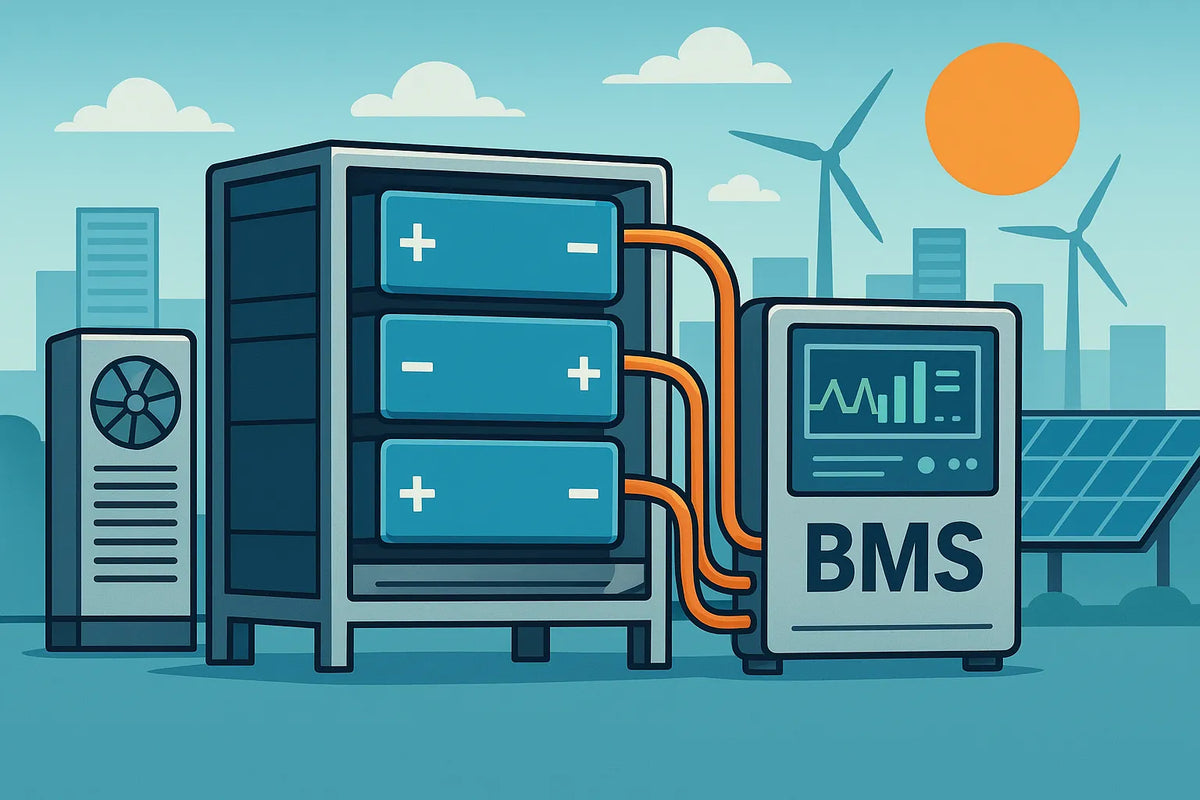
Battery technology has advanced rapidly, but cell chemistry alone no longer determines performance. Modern systems rely on intelligent controls to protect energy assets, extend service life, and squeeze every watt of value from each charge cycle. This is where Battery Management Systems, or BMS, have become the heart of the energy-storage ecosystem.
Demand for smarter BMS platforms surged as global storage deployment accelerated. The International Energy Agency reports more than 50 GWh of stationary storage additions in 2023, with double-digit growth expected through the decade. These installations must deliver stable power even under harsh environmental and load conditions. A sophisticated BMS is essential to keep cells operating safely while supporting fast response times and long-term reliability.
NEC has stood at the center of this transition. With decades of experience in both electronics and large-scale power systems, the company developed BMS technologies designed for demanding industrial and utility applications. Many of NEC’s deployments operate in regions where grid conditions fluctuate, temperatures swing sharply, or renewable energy output varies throughout the day. These challenges shaped a BMS philosophy built on precision, redundancy, and predictive control.
What sets NEC apart is its systems-level view. Instead of treating the BMS as a simple protective layer, NEC integrates it into a broader digital ecosystem that spans from cell-level balancing to fleet-wide analytics. This approach allows operators to track degradation, adjust thermal controls, and prevent failures before they occur. It also enables the kind of grid services—such as frequency regulation and peak-shaving—that require fast and accurate system responses.
This article explores NEC’s innovations in detail. It outlines the company’s evolution in BMS design, examines the architecture behind its modern platforms, and presents real-world performance data from global deployments. It also looks ahead at how NEC plans to push BMS intelligence further as the energy landscape shifts.
The Evolution of NEC’s Battery Management Strategy
Early Foundations in Battery and Control Engineering
NEC’s work in batteries stretches back decades, long before the global boom in energy storage. The company produced lithium-ion cells for consumer and industrial electronics through the 1990s and early 2000s. This experience gave NEC a detailed understanding of how cells behave under stress, temperature variation, and heavy cycling. It also helped the company identify the limits of early BMS platforms, which often relied on basic voltage and temperature checks.
As industries adopted larger battery packs, NEC recognized a growing need for smarter supervisory controls. Small failures that were manageable in laptops became serious risks when multiplied across thousands of cells. NEC’s design teams began rethinking BMS architecture, shifting from simple protection circuits to multi-layer monitoring systems capable of acting in real time.

Shift Toward Utility-Scale Energy Storage
By the early 2010s, NEC had expanded into grid-scale storage through NEC Energy Solutions (formerly A123 Energy Solutions). This segment required a new class of BMS. Utility projects operated in harsh settings, including remote deserts, coastal regions, and dense urban grids with volatile load patterns. The systems had to respond quickly to frequency changes while avoiding degradation caused by irregular dispatch cycles.
During this period, NEC deployed several landmark projects. One example is the 50 MW storage installation in Northern Ireland, built to support grid stability during renewable fluctuations. Operational data showed that frequent cycling and rapid charge-discharge patterns placed enormous strain on individual cells. NEC’s engineers began enhancing algorithms to maintain cell balance under these dynamic conditions.
The company also gathered insights from deployments in Japan and the United States, where grid operators required precise control during peak demand events. This data helped NEC refine its BMS thresholds and fault-detection logic, ensuring that systems would remain safe even during rare but severe grid disturbances.
Data-Driven Development From Global Installations
Real-world feedback became a key part of NEC’s innovation cycle. Each storage installation generated millions of data points covering voltage drift, thermal gradients, cycle life, and failure modes. Instead of treating the BMS as a closed device, NEC developed diagnostic layers that fed information back into engineering teams. This continuous loop enabled the company to fine-tune balancing routines and predictive maintenance rules based on actual field behavior.
As the dataset grew, NEC observed trends that shaped the next generation of its BMS approach. For example, consistent patterns of heat accumulation appeared in rack corners exposed to uneven airflow. NEC adjusted its thermal-control algorithms to account for these localized hotspots. Another insight involved aging drift, as older cells showed nonlinear deviations during fast-charging events. These deviations were integrated into predictive models to protect modules nearing the end of life.
Responding to Safety Challenges Across the Industry
Several high-profile battery fires across the energy-storage sector pushed NEC to strengthen its safety protocols. Industry investigations revealed that many incidents stemmed from incomplete monitoring layers or slow response times. NEC took a conservative approach by expanding redundancy within its BMS hierarchy. The company added cross-checks between cell, module, and rack controllers to detect anomalies before they could escalate.
NEC also integrated thermal-runaway mitigation strategies based on lessons learned from early lithium-ion failures worldwide. These strategies included rapid isolation features, automated cooling-activation triggers, and controlled shutdown procedures. Together, they reduced the likelihood that a small fault could cascade into a system-level incident.
A System-Level Philosophy Takes Shape
By the mid-2010s, NEC’s BMS strategy had evolved into a comprehensive, multi-tiered framework. The company no longer viewed the BMS as a simple protective layer. Instead, it became a digital backbone that connected sensors, modules, racks, and supervisory software into a single ecosystem. This system-level view allowed greater control over energy throughput, thermal distribution, and long-term asset health.
NEC’s AEROS control platform emerged from this philosophy, offering advanced analytics, automated dispatch, and predictive maintenance capabilities. It enabled operators to manage fleets of batteries across multiple sites through a unified dashboard. This evolution marked NEC’s shift from a cell manufacturer to a full-scale energy-solutions provider with deep expertise in digital battery intelligence.
Core Innovations in NEC’s BMS Architecture
A Multi-Layer Control Hierarchy
NEC designs its BMS around a structured control hierarchy that operates at the cell, module, rack, and system levels. This layered approach creates redundancy and ensures rapid response to changing conditions. Each layer handles specific roles, from precise voltage monitoring to large-scale power dispatch decisions.
Cell-level controllers track micro-variations in voltage and temperature. Module controllers aggregate this data and balance energy across groups of cells. Rack controllers synchronize multiple modules to maintain safe thermal profiles and uniform degradation. At the top sits NEC’s supervisory control platform, which coordinates the entire site and interfaces with the grid.
This hierarchy allows operators to detect and respond to faults within milliseconds. It also prevents local issues from escalating into system-wide failures.
Precision Cell Balancing Algorithms
NEC applies active and passive balancing strategies to maintain uniform cell performance. The company’s algorithms analyze voltage distribution, internal resistance, and historical degradation patterns. These metrics guide the BMS in redistributing energy more effectively, especially during fast-charging cycles.
Field data from NEC’s utility-scale systems shows that precise balancing reduces capacity fade by 5–8% over typical five-year operating windows. This improvement extends usable life, lowers replacement costs, and stabilizes system performance during high-demand dispatch.
Advanced Thermal Management
Heat is one of the primary drivers of accelerated battery wear. NEC integrates thermal sensors throughout each rack to detect temperature gradients with high accuracy. The BMS uses this data to modulate airflow, adjust cooling cycles, and prevent localized hotspots that can trigger degradation.
One significant feature is NEC’s predictive thermal modeling. This tool simulates heat flow across modules under various load conditions. Operators receive early warnings when thermal behavior deviates from expected patterns. These alerts help prevent failures and reduce downtime.
Predictive Analytics and Degradation Modeling
NEC incorporates machine-learning-based models to predict cell aging. These models use long-term operational data to estimate internal resistance growth, capacity decline, and thermal stress accumulation. The system then adjusts operating thresholds to reduce strain on aging cells.
This predictive layer improves reliability in long-duration projects such as frequency regulation or peak shaving. It also provides asset managers with accurate forecasting for maintenance schedules and replacement planning.
Cybersecurity Integration Across Platforms
Modern energy storage assets connect to digital grids, making cybersecurity a critical requirement. NEC embeds multi-layer protection within its AEROS and DSS control platforms. These protections include encrypted data channels, authenticated command structures, and continuous anomaly detection.
The cybersecurity framework aligns with standards used in critical infrastructure environments. It also reduces the risk of unauthorized access, which has become a growing concern for grid operators.
Advanced Diagnostics and Real-Time Monitoring
NEC’s diagnostic tools help operators pinpoint abnormalities quickly. Real-time dashboards display cell voltages, temperatures, state-of-health metrics, and cycle counts. Operators can isolate modules or racks within seconds if they detect unusual patterns. This capability shortens response time and reduces potential damage.
The BMS also logs every event, from minor voltage drift to major fault triggers. These logs create a detailed operational history that guides ongoing optimization.
Comparison Table: NEC BMS vs. Conventional Systems
| Feature Category | NEC BMS Architecture | Typical Conventional BMS |
|---|---|---|
| Control Structure | Multi-layer (cell → module → rack → system) | Module-level only |
| Cell Balancing | Advanced active + passive algorithms | Basic passive balancing |
| Thermal Management | Predictive thermal modeling + dense sensor array | Limited temperature sensing |
| Predictive Analytics | Machine-learning degradation models | Simple cycle counting |
| Cybersecurity | Encrypted channels + authenticated commands | Minimal or no cybersecurity layer |
| Diagnostics | Full real-time dashboards + event history | Basic fault reporting |
This combination of hardware intelligence and data-driven software sets NEC apart from competitors. It creates a more resilient storage architecture suitable for demanding industrial, commercial, and utility environments.
Real-World Performance Gains and Industry Applications
Improved Efficiency in Utility-Scale Projects
NEC’s BMS has delivered measurable gains across large energy-storage sites. Data from multi-megawatt installations in Europe and Asia shows that optimized cell balancing and predictive controls increase round-trip efficiency by 2–4%. This improvement may appear modest, but the financial impact is significant at grid scale. It translates into higher delivered energy and reduced operational costs over the asset’s lifetime.
These gains also help grid operators respond more effectively to demand spikes. Faster system responses allow storage units to deliver regulatory services such as frequency regulation with greater accuracy. This reliability is one reason NEC installations have been included in high-priority stabilization programs across several markets.
Enhanced Safety and Failure Prevention
Safety remains the core focus for any BMS. NEC’s multi-layer protection architecture has reduced the likelihood of thermal events across its deployed fleet. Operators have reported fewer overheating incidents and faster intervention times when early warning indicators appear. The system isolates faults at the module or rack level before they can escalate.
NEC’s predictive diagnostic tools also improve safety outcomes. By identifying abnormal aging patterns early, technicians can replace or isolate modules that show elevated risk. This reduces both downtime and the chance of catastrophic failure.
Commercial and Industrial Use Cases
NEC’s BMS plays a major role in commercial facilities participating in demand-response and peak-shaving programs. Buildings equipped with NEC storage systems have seen notable reductions in peak electricity charges. These savings stem from precise dispatch control, which allows facilities to offset high-price grid usage during critical hours.
Businesses with sensitive equipment, such as manufacturing lines or data centers, benefit from improved power quality as well. NEC’s fast-response algorithms deliver stable voltage support, preventing fluctuations that could disrupt operations or damage equipment.
Example Applications in C&I Settings
- Demand-charge reduction for large retail and logistics centers
- Voltage support for facilities with sensitive automation
- Backup power during grid outages
- Integration with rooftop solar to store surplus production
Supporting Renewable Energy and Microgrids
Microgrid developers rely on NEC’s BMS to stabilize remote or isolated networks. These systems often integrate solar, wind, and backup generators. NEC’s real-time monitoring helps balance energy flows during rapid shifts in renewable output. The BMS ensures that battery reserves are ready when clouds reduce solar production or when wind output declines.
Several island microgrids using NEC systems have reported improved fuel savings due to optimized generator cycling. The BMS orchestrates energy sources so that diesel generators run fewer hours while maintaining stable frequency and voltage.
Lifecycle Cost Reduction and Long-Term Value
One of the strongest benefits of NEC’s BMS is extended battery service life. Field results indicate that advanced balancing, thermal controls, and predictive modeling reduce annual degradation rates. Some long-duration deployments have achieved up to 10% longer operational life compared to similar systems without advanced analytics.
Longer service life decreases replacement frequency, which is a major cost factor in energy-storage projects. Combined with higher efficiency and improved uptime, these gains contribute to lower total cost of ownership.

Future Outlook: How NEC Plans to Push BMS Further
Toward Autonomous Energy Optimization
NEC is preparing the next generation of BMS capable of autonomous decision-making. These platforms will use real-time data streams to predict grid fluctuations and adjust battery behavior without human intervention. The goal is to reduce operator workload while improving responsiveness during unpredictable events.
Future systems will analyze weather forecasts, market signals, and load profiles. This information will guide charge-discharge schedules and maintain battery health. NEC expects automation to become essential as renewable penetration grows and grid conditions change more rapidly.
AI-Driven Predictive Controls
Artificial intelligence is set to play a larger role in NEC’s BMS roadmap. Machine-learning models will gain deeper insights into cell aging, thermal risk, and operational efficiency. These models will highlight subtle warning signs that traditional diagnostics may overlook.
AI-enhanced BMS tools will recommend maintenance actions and adjust system thresholds to prevent unnecessary stress. Over time, this intelligence could reduce degradation even further and extend battery life beyond current expectations.
Integration With Broader Energy Ecosystems
The future of energy storage lies in seamless integration with other technologies. NEC’s upcoming architectures aim to operate within hybrid environments that combine batteries, renewables, electric vehicles, and backup generation. This will allow microgrids and utility sites to run more smoothly and respond faster to rapid shifts in supply and demand.
Vehicle-to-grid (V2G) support is another area of interest. As EV adoption rises, NEC’s systems may coordinate mobile energy resources with fixed storage assets. This coordination will unlock new forms of grid flexibility.
Meeting New Regulatory and Cybersecurity Demands
Energy storage now plays a critical role in national infrastructure. As a result, cybersecurity standards continue to tighten. NEC is expanding its protection frameworks to exceed upcoming regulations. These updates will include deeper network segmentation, stronger authentication layers, and more advanced intrusion-detection tools.
Regulatory agencies are also pushing for higher transparency in operational data. NEC is developing reporting tools that simplify compliance while giving operators clearer insights into system behavior.
Scaling for Global Deployment
The next challenge for NEC is scale. Global storage deployment is expected to surpass 150 GWh per year by 2030, according to the International Energy Agency. Meeting this demand requires standardized, modular BMS components that can be deployed quickly and configured across diverse environments.
NEC is working to streamline commissioning, remote monitoring, and lifecycle management. These improvements will support faster project development without compromising safety or performance.
Looking Ahead
NEC’s innovations reflect a long-term commitment to safer, smarter, and more efficient battery systems. The company is shifting from traditional protection-based BMS design to intelligent, predictive, and ecosystem-aware architectures. This shift will be essential as the world accelerates toward higher renewable penetration and increased electrification.
For operators, engineers, and energy planners, NEC’s future roadmap promises tools that provide clearer insights, reduced risks, and stronger performance across decades of use. The next phase of battery management will rely as much on data and intelligence as on hardware, and NEC is positioning itself to lead that transition.
