
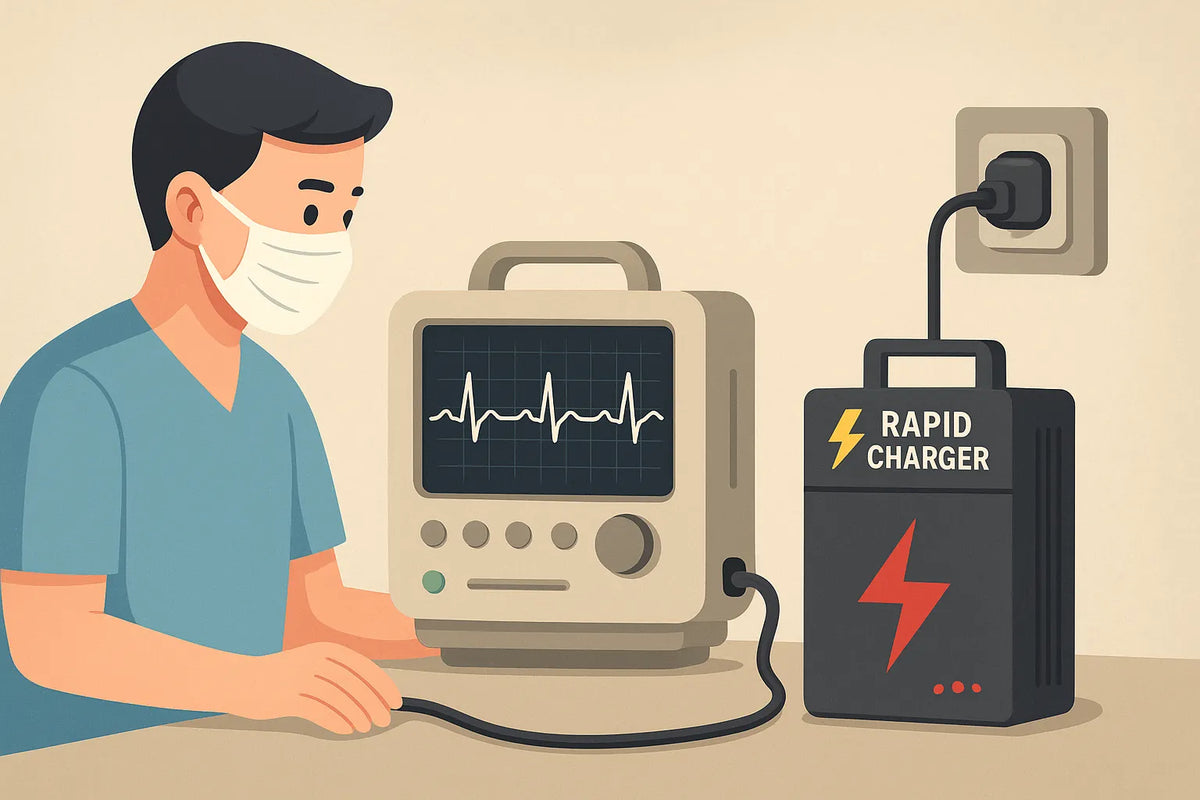
Electrocardiogram (ECG) monitors rely on rechargeable lithium-ion or lithium-polymer batteries to keep patient readings stable throughout long clinical shifts. As hospitals look for faster turnaround and higher device availability, rapid-charging systems have become more common. These chargers can replenish a depleted pack far quicker than standard units, reducing downtime and improving patient monitoring continuity.
Yet this convenience carries a cost. Fast charging increases internal temperature, accelerates chemical aging, and may shorten a battery’s cycle life. A study published by the U.S. Department of Energy showed that high-rate charging can reduce lithium-ion battery life by 15–30%, depending on the charge rate and temperature conditions. Clinical environments, where monitors operate for many hours each day, can amplify these effects.
Healthcare facilities depend on accurate and uninterrupted ECG data. A weak or unstable battery can compromise signal quality, reduce runtime, and increase maintenance workload. Understanding how rapid-charging influences degradation is essential for biomedical engineers and clinical technicians responsible for equipment reliability.

How Rapid-Charging Alters Battery Chemistry in ECG Devices
Rapid-charging technology works by supplying a higher current to the battery, forcing lithium ions to move more quickly between the anode and cathode. While this speeds up the replenishment process, it also changes the chemical environment inside the cell. These alterations can reshape how the battery ages over time, especially in medical devices that operate many hours each day.
One of the most significant effects is heat generation. When charge current increases, resistance inside the cell converts more energy into heat. Research from the National Renewable Energy Laboratory shows that a temperature rise of 10°C can nearly double the rate of chemical degradation in a lithium-ion cell. Even small thermal spikes can alter the solid electrolyte interphase (SEI) layer, which protects the anode. When this layer becomes unstable, the battery begins to lose capacity more quickly.
High-current charging also increases the risk of lithium plating. This occurs when lithium deposits form on the anode instead of intercalating into it. Plating reduces usable capacity and raises internal resistance. In severe cases, it can create micro-shorts that compromise device safety. Medical-grade batteries include protective circuitry, but these systems cannot fully eliminate the chemical changes caused by aggressive charging cycles.
Voltage stress is another contributor to early wear. Fast charging often maintains higher voltages for longer periods, pushing the cell closer to its upper limits. Prolonged exposure at these levels can cause cathode oxidation. Over time, this reduces cycle life and increases the likelihood of calibration drift, which may indirectly affect ECG performance in extreme cases.
For ECG monitors, stable power delivery is essential. Rapid-charging disrupts the careful balance of temperature, ion movement, and protective layer formation that keeps medical batteries healthy. These changes do not destroy a battery immediately, but they create cumulative wear that becomes more noticeable after repeated high-current sessions.
Cycle Life Reduction: What the Data Shows
Cycle life describes how many full charge–discharge cycles a battery can complete before its capacity drops to 80% of its original rating. Medical-grade lithium-ion cells used in ECG monitors typically last 300–500 cycles under standard charging conditions. However, fast-charging can shorten this lifespan significantly, especially when temperature fluctuations are involved.
Several laboratory studies confirm this trend. Research published by the Journal of Power Sources found that cells charged at 2C rates—a common threshold for rapid charging—lost 20–28% more capacity after 300 cycles compared to cells charged at slower 0.5C rates. This decline occurred even though both sets operated within the manufacturer’s safe voltage limits. The primary difference was heat and plating formation during high-rate charging.
Real-world observations from clinical engineering teams align with these findings. Hospitals that upgraded to rapid-charging docks reported that ECG monitor batteries required replacement 6–12 months earlier on average. Many technicians noted symptoms such as shorter runtime, higher self-discharge, and longer calibration time after aging accelerated. These issues were especially common in units used around the clock, where batteries rarely cool fully between shifts.
The financial impact can be substantial. Battery replacements account for a meaningful portion of ECG monitor maintenance budgets. When cycle life decreases, hospitals must purchase new packs more often and schedule more frequent servicing. This cost compounds across large fleets of bedside monitors, making battery management an important factor in overall device reliability.
The data is clear: rapid-charging does improve availability, but it measurably reduces cycle life. The challenge for clinical teams is finding a balance between operational efficiency and long-term battery health.

Degradation Patterns in Clinical Use
ECG monitor batteries follow distinct degradation patterns when exposed to rapid-charging in everyday hospital settings. These patterns differ from controlled laboratory aging because clinical use introduces irregular discharge cycles, temperature shifts, and periods of high demand during patient transport or emergencies.
One of the most common patterns is accelerated capacity fade. Batteries that experience multiple fast-charge sessions per day often show a noticeable drop in runtime after only a few months. Technicians report that some packs fall from six hours of operation to less than four hours in this period. This reduction is driven by cumulative SEI breakdown and internal resistance growth triggered by repeated thermal stress.
ECG monitors also experience higher voltage drift as batteries degrade. This drift can cause the device to recalibrate more frequently, especially during long monitoring sessions. Although the drift rarely affects the accuracy of the ECG signal itself, it can increase maintenance tasks. Biomedical engineers often see these symptoms earlier in fleets that rely heavily on rapid chargers.
Another degradation pattern involves rising internal resistance. As resistance increases, the battery becomes less efficient at delivering stable power during sudden current spikes, such as when alarms sound or when data transmission peaks. Devices may restart, display low-battery warnings prematurely, or shut down unexpectedly if the resistance climbs too high. These events are infrequent but more common in units with high fast-charge exposure.
Finally, irregular heat accumulation contributes to non-uniform cell aging. Some hospital environments have limited ventilation around charging docks, which traps heat during back-to-back charging sessions. Batteries exposed to higher ambient temperatures—especially above 30°C—tend to degrade faster. This uneven aging can lead to unpredictable behavior and shorter service intervals.
Overall, the degradation seen in clinical use reflects a combination of chemical wear, thermal conditions, and charging habits. Understanding these patterns helps teams design maintenance schedules that minimize downtime and extend device reliability.

Best Practices for Extending ECG Battery Lifespan
Hospitals can slow battery degradation by adjusting charging routines and improving thermal conditions. These changes do not eliminate the effects of rapid-charging, but they help reduce unnecessary stress that shortens cycle life. Small adjustments often produce meaningful gains in reliability and reduce long-term replacement costs.
One effective approach is alternating between rapid-charging and standard charging. Many manufacturers recommend using fast chargers only when quick turnaround is necessary. Standard chargers keep temperatures lower and place less voltage stress on the cells. This mixed strategy helps protect the SEI layer, which plays a key role in long-term stability and cycle life retention.
Keeping charging areas cool also has a major impact. A study from the Department of Energy showed that lithium-ion cells stored or charged above 30°C age nearly twice as fast as those kept around 20–25°C. Improving airflow near charging stations or moving chargers away from heat sources can significantly slow capacity fade in busy departments.
Battery rotation is another proven method. When devices share a common pool of batteries, no single pack absorbs a disproportionate number of charge cycles. Rotating packs through a documented schedule spreads wear evenly and reduces sudden failures. Biomedical technicians often pair this with routine capacity checks to identify early signs of resistance growth or voltage instability.
Software-based charge management can also support battery health. Some modern ECG monitors and charging stations allow staff to set upper charge limits, such as stopping at 90–95% instead of reaching a full 100%. Reducing the time spent at high voltage levels slows cathode oxidation and extends usable life. This method works especially well for devices that spend long periods connected to a charger.
Finally, staff training is essential. Many early failures occur because batteries are kept on rapid chargers unnecessarily, or because packs are left in hot environments after use. Teaching clinical teams simple habits—like allowing devices to cool before charging or avoiding consecutive fast-charge sessions—helps protect batteries without disrupting patient care.
These practical steps allow hospitals to enjoy the convenience of rapid-charging while maintaining stable ECG performance and reducing replacement frequency. By approaching battery management proactively, clinical teams can safeguard equipment longevity and ensure consistent monitoring for every patient.
